

May 26, 2026 – BYD has further expanded its European commercial vehicle footprint with the delivery of 23 full-size electric buses to EMT Palma, the public transit authority serving Palma de Mallorca, the capital of Spain’s largest Balearic island.
Each 12-meter coach carries a price tag of €573,000 — a figure roughly four times higher than what a comparable model commands in China, where similar 12-meter electric buses typically sell for between 800,000 and 1.2 million yuan in public tenders. The steep premium reflects the added costs of EU certification, localized adaptation, after-sales support networks, and labor overheads across the continent.
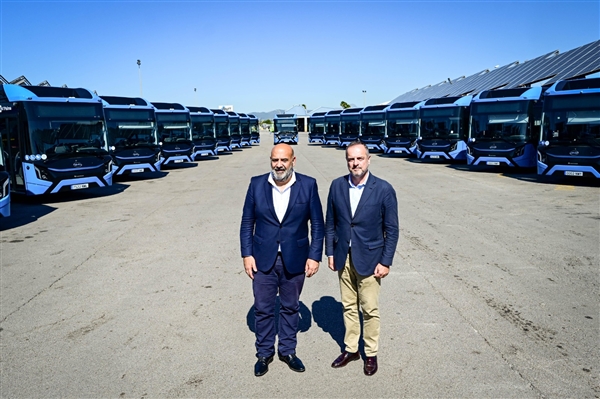
The buses are built on BYD’s Nelec platform, a product of collaboration between the Chinese EV giant and Spain’s Castrosua. Under the arrangement, BYD supplies the electric powertrain and blade-type LFP battery pack, while Castrosua handles body construction and final assembly. Engineered to comply with Europe’s rigorous operational benchmarks, the vehicles prioritize extended range, passenger safety, and low energy consumption.
This delivery is the first tranche of a much larger electrification push. In March 2025, EMT Palma approved a €117 million procurement plan to acquire 113 electric buses — 67 articulated 18-meter units and 46 standard 12-meter models — alongside the charging infrastructure needed to run them. In the initial tender covering 68 vehicles, BYD won the contract for 23 standard buses, while German automaker Daimler took home the order for 34 articulated coaches at €799,800 per unit.
So far, nine of the BYD buses have already hit the road, serving routes 1, 6, 10, and 14. The remaining 14 are undergoing registration and system calibration before entering service.
Palma’s Mayor Jaime Martínez Llabrés described the rollout as a pivotal move in the city’s transition to greener mobility, noting it brings the municipality closer to its goal of electrifying more than half its bus fleet by 2027.
What makes BYD’s win particularly notable is that it managed to beat entrenched European players like Daimler in a head-to-head contest. Industry analysts attribute the victory to the maturity of BYD’s electric drivetrain technology, the proven durability of its products, and a well-established local service presence — advantages that appear to outweigh the brand-recognition edge held by legacy European manufacturers.