





July 10, 2026 –DJI has hosted an exclusive briefing event in Shenzhen to unveil its brand-new DJI EV50, marking the company’s very first vertical takeoff and landing (VTOL) cargo drone that merges convenient hover takeoff capabilities with long-distance cruising performance, alongside massive upgrades in payload capacity and flight endurance compared to its prior aerial devices.
Boasting a silhouette that stands out sharply from DJI’s lineup of compact multirotor drones, the EV50 features a streamlined hawk-like aerodynamic frame with a wingspan stretching to seven meters. Built into the airframe is a 270-liter integrated cargo hold; supplies can be easily loaded through an opening at the nose, with the unit supporting a maximum carrying weight of 50 kilograms. Its power system combines eight vertical rotors and three dedicated thrust motors. The rotors deliver stable hovering for takeoff and landing, while the fixed wings take over forward propulsion during cruise flight to cut power consumption significantly. With zero runway requirements, the drone can operate seamlessly across rugged mountain zones, remote islands and disaster-hit areas where ground transportation links have been severed. It achieves a maximum flight range of 150 kilometers without cargo, and retains a 70-kilometer flight radius under standard loaded conditions.
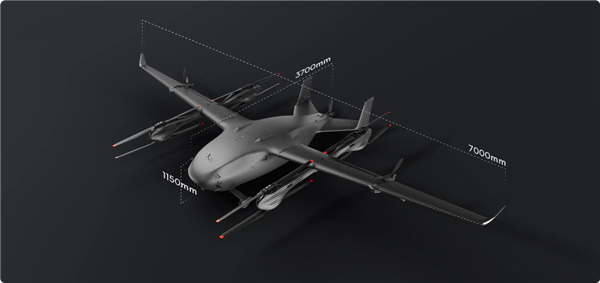
Engineers outfitted the aircraft with a comprehensive cold-resistant and anti-icing suite to withstand harsh operating conditions. Built-in heating films are fitted to its batteries, while airspeed sensors mounted on the airframe come with automatic de-icing functionality. The drone maintains steady operation even at temperatures as low as minus 20 degrees Celsius and altitudes exceeding 5,000 meters above sea level.
Prior to official launch, the EV50 endured hundreds of rigorous extreme-condition test flights throughout its development cycle. The platform also completed real-world scientific research missions near Mount Everest, reaching a peak altitude of 8,861 meters over 32 separate flights. These trips collected invaluable atmospheric measurement datasets that were previously hard to obtain using conventional field equipment.
Running entirely on electric power, the EV50 produces no exhaust emissions and generates minimal airflow turbulence mid-flight. Paired with high-precision sensing hardware, it eliminates contamination risks to environmental sampling materials, fixing critical limitations seen in traditional research aircraft. Multiple redundant safety systems are integrated to safeguard operations: four separate battery packs and redundant control surfaces allow the drone to stay airborne smoothly even if a single component malfunctions. A whole-aircraft parachute system is also installed to facilitate a slow, controlled descent in the event of critical failures.
Beyond atmospheric research and field surveys, the new cargo drone unlocks practical logistics use cases for isolated communities. During natural disasters including floods and landslides, it can rapidly deliver medical supplies and drinking water to restore supply routes cut off by damaged roads.
DJI dedicated five years to developing the EV50, iterating through dozens of airframe structural designs to strike an optimal balance between load capacity, flight range and operational expenses. The finished product represents a fully commercialized large-scale cargo drone ready for widespread real-world deployment.