

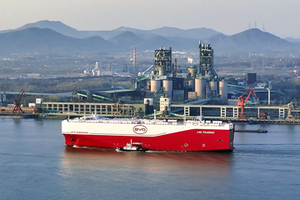




September 14, 2026 – According to the Middle Eastern maritime magazine Robban Assafina, citing multiple industry chain sources and quotation information on LinkedIn, BYD has placed an additional order for 10 9,200 CEU (standard car units) Pure Car and Truck Carriers (PCTC). These new vessels will be identical to the “BYD Shenzhen,” currently the world’s second-largest car carrier.
Once delivered, this new order will expand BYD’s operating fleet to 18 vessels, with a combined transport capacity of over 130,000 cars.
The 10 new ships will be built by China Merchants Industry at its Jinling and Haimen shipyards, with deliveries scheduled in batches between 2027 and 2029.
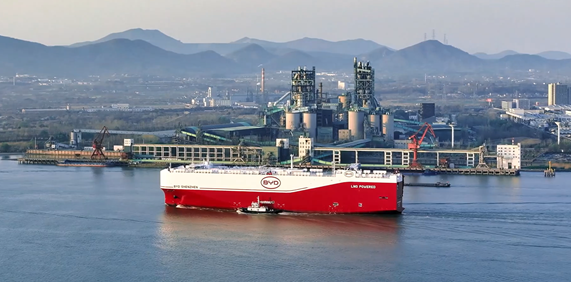
All vessels will be powered by LNG dual-fuel engines and have a capacity of 9,200 standard car units each. They will be the second-largest car carriers in operation globally (the largest being the 10,800-car LNG vessel built by CSSC Guangzhou International for South Korea’s HMM).
BYD’s journey of building its own fleet for overseas expansion began in early 2024. In January of that year, its first transport ship, “BYD Explorer No.1,” set sail fully loaded from Yantai Port. With a capacity of 7,000 CEU, it was built by CIMC Raffles.
Subsequently, BYD rapidly expanded its fleet at an average pace of one delivery every two to three months. Ships including the Changzhou, Hefei, Shenzhen, Xi’an, Changsha, Zhengzhou, and Jinan were successively put into service, forming a complete fleet of 8 vessels by September 2025.
Among them, the “BYD Shenzhen,” delivered in April 2025, measures 219.9 meters in length and 37.7 meters in width, featuring 16 decks and a service speed of 19 knots. It was the world’s largest car carrier at the time. The combined capacity of these 8 ships already exceeds 1 million vehicles annually.
The fundamental reason behind BYD’s massive investment in building its own fleet lies in the contradiction between the explosive growth of Chinese car exports and the severe shortage of global shipping capacity.
In the first eight months of 2026, BYD’s overseas sales reached 1.158 million units, accounting for over 40% of its total sales. However, the widening gap in global roll-on/roll-off (RoRo) shipping capacity has, to some extent, affected the delivery speed of domestic automakers going global.
Furthermore, BYD is not the only Chinese automaker building its own fleet. Companies such as SAIC, Chery, and Changan have also placed orders for their own transport vessels. However, BYD currently leads the pack in both scale and speed.