




October 23, 2026 – Moonshot AI (Kimi) officially released its Kimi K3.1 Pro model, which the company describes as its most capable 3-trillion-parameter model to date, supporting a 1-million-Token context window.
As a post-training variant of K3, K3.1 Pro benefits from substantially increased post-training compute and large-scale reinforcement learning across hundreds of downstream domains, delivering comprehensive improvements in every area. A high-speed variant, K3.1 Pro Highspeed, was also launched simultaneously, offering comparable intelligence with output speeds roughly two to three times faster than the standard version.
Both models are available from today via kimi.com, the Kimi App, Kimi Work, Kimi Code and Kimi API. Full model weights will be published before November 4.
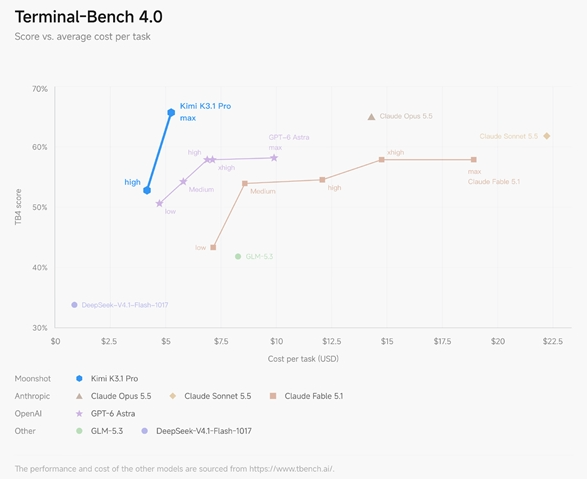
Code generation and long-horizon agents are the centerpiece of this upgrade. Moonshot claims the model reaches or approaches the performance of the strongest closed-source models on code, agent and knowledge benchmarks. In Terminal-Bench 4.0, which evaluates performance on real terminal-constrained tasks, K3.1 Pro scored 65.7%, outperforming GPT-6 Astra’s 58.2% and narrowly trailing Claude Opus 5.5’s 66.4%. On the internal Kimi Code Bench 3.0 Long-horizon, it scored 61.2%, up from K3’s 55.95%.
The model can skillfully invoke game engines such as Unity, Unreal Engine and Godot, and directly write and run Blender and CAD scripts for parametric 3D modeling. On BenchCAD with tool use, it scored 92.7%, close to Claude Opus 5.5’s 96.2% and GPT-6 Astra’s 95.9%.
In finance, the model can deliver end-to-end workflows covering financial modeling, investment analysis and industry research reports, scoring 64.4 on the external benchmark OfficeQA Pro v2 — a result Moonshot says is the current best available.
On factual accuracy, internal stress tests (Kimi Hallu Bench Hard) show the per-statement factual error rate dropping from K3’s 23.4% to 8.3%, and the share of responses containing at least one factual error falling to roughly 42.4% of the previous generation. Moonshot emphasized that the test deliberately targets error-prone scenarios and the reported error rate does not reflect overall performance in everyday use.
On safety, the company said it identified and removed cyber attack and defense-related data during both mid-training and reinforcement learning phases to reduce misuse risk. On its self-developed xdev-bench-hard, the unfiltered model passed@3 on 90.5% of tasks, while the final released version scored 81.0%.