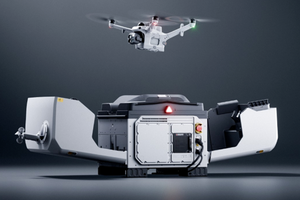





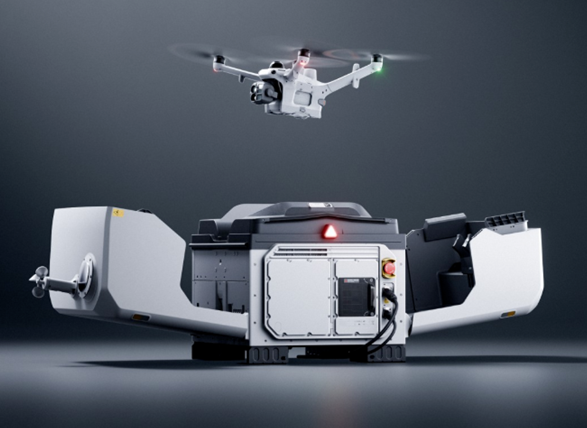
October 15, 2026 – DJI has officially launched its first battery-swapping unmanned platform, the DJI Dock 4, priced at 167,999 yuan for the hardware bundle. The package includes the Dock 4 station, a DJI Matrice 5TD drone, a DJI O4 Ground Station and four batteries. Software subscriptions, maintenance and additional services are sold separately.
The biggest upgrade is 25-second automatic battery swapping. The drone can take off again within about 45 seconds, cutting the previous roughly 30-minute charging interval down to seconds. During the swap, flight data is uploaded simultaneously, making the system better suited for emergency response, power-line inspection and large-event security.
The Dock 4 supports “open-and-fly” remote operations, so no pilot needs to be on site. The Matrice 5TD can reach speeds of up to 21 m/s, has a maximum flight time of 59 minutes, and the dock itself can operate in temperatures from -40°C to 50°C. Multiple docks can also rotate drones to maintain continuous patrol coverage.
On the imaging side, the Matrice 5TD integrates a long-zoom camera, infrared, laser rangefinder and full-color night vision. Its 11x optical zoom can identify license plates within 400 meters and detect small defects such as bolts or pins within 100 meters. The infrared camera resolution has been raised to 1280×1024, reaching 2560×2048 in super-resolution mode, with 2K video recording and 32x digital zoom. It also supports full-color 4K high-frame-rate night vision without external spotlights.
The drone carries up to 450 grams of payload and offers three external mounting points for accessories such as loudspeakers, spotlights and parachutes. For flight safety, it uses millimeter-wave radar, LiDAR and six-directional visual perception, along with anti-interference, anti-spoofing and high-wind return-to-home functions.
AI is another key upgrade. The Matrice 5TD’s onboard AI can identify 17 types of targets, including vehicles, boats and smoke, and supports third-party custom models. Through the DJI FlightHub 2 platform, users can search for targets using text or images. When abnormalities are detected, the system can send alerts and automatically capture photos, record video, follow or hover. After missions, AI can compare new footage with historical images or 3D models to highlight changes and generate reports.