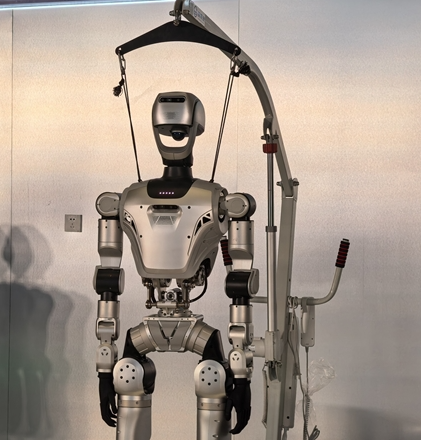

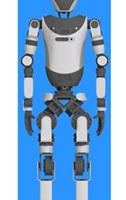


October 10, 2026 – China’s National Intellectual Property Administration has published a design patent for an embodied intelligent robot, with BYD Co. Ltd. listed as the patent holder. This marks the first formal public disclosure of the appearance of BYD’s self-developed humanoid robot.
The patent’s authorization announcement number is CN 310247768 S. The authorization announcement date is October 6, 2026, the application number is 202630215763.1, and the filing date is April 30, 2026. The designers are Tu Xiaoping, Fan Yun, Li Dong, and Zhang Youwen, and the patent agency is Beijing Tongli Juncheng Intellectual Property Agency Co., Ltd. Classified under LOC(15) Cl. 15-99, the product is named “embodied intelligent robot,” with eight drawings and one page of brief description.
According to the patent drawings, the robot adopts a black-and-white color scheme. Its head features a smooth, rounded surface without a prominent display screen or facial features. The torso, arms, and legs include numerous joint structures, giving the limbs clear ranges of motion. Key joints at the shoulders, elbows, hips, and knees appear as black spherical or hinge mechanisms, while white shells cover the main limb segments, creating an industrial mechanical aesthetic. The patent includes front, rear, top, bottom, and perspective views.
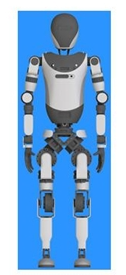
This robot corresponds to BYD’s previously announced humanoid robot codenamed “Xiao Di.” Official specifications state that Xiao Di stands 1.61 meters tall, weighs 58.5 kilograms, and has 31 degrees of freedom across its body. Its dexterous hands can achieve a repeatable positioning accuracy of ±1 millimeter, enabling complex tasks such as object grasping, gesture interaction, and guided demonstrations. More than 60 percent of its components are shared with other systems, and its self-developed content rate exceeds 80 percent.
Xiao Di is positioned as a commercial service robot, with its initial deployment focused on retail stores rather than factories. Li Ke, BYD’s executive vice president, has said the company aims to place two to three robots in each store to assist sales staff with standardized tasks such as product explanations and demonstrations, while final purchasing decisions will remain with human employees. The robot also supports dialect recognition to better fit in-store reception scenarios.
In early August, Xiao Di made its global public debut at BYD’s “Di Space” in Zhengzhou. Earlier rumors in June about a BYD humanoid robot codenamed “Yao Shun Yu” and plans to deploy 20,000 units internally within the year were denied by the company.