



August 3, 2026 –Alibaba has fired its latest salvo in the global AI arms race with the official launch of Qwen3.8, a next-generation foundation model that pushes the boundaries of both coding autonomy and visual reasoning. The flagship variant, Qwen3.8-Max, packs a staggering 2.4 trillion total parameters with 95 billion activated, making it the largest and most powerful member of the Qwen family to date.
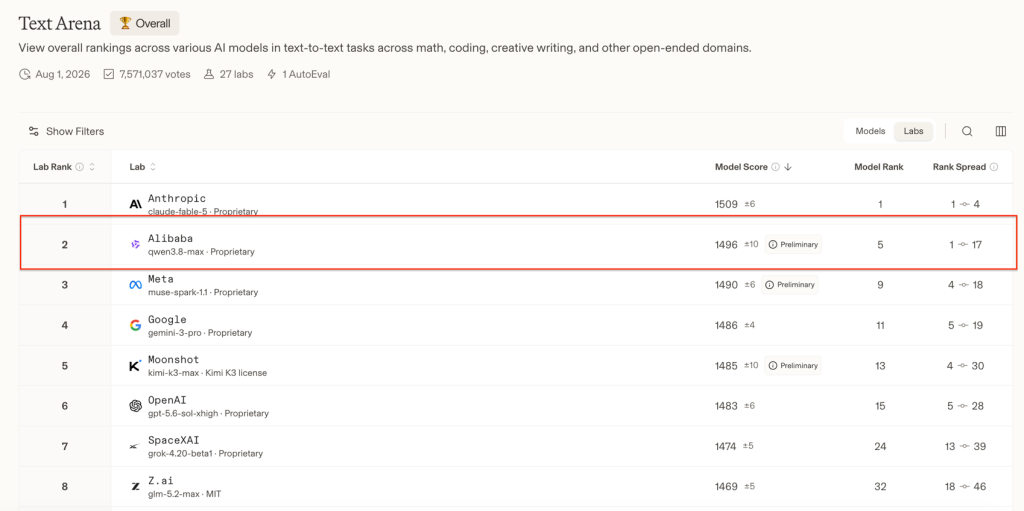
According to today’s update from the authoritative Arena leaderboard, Alibaba’s Qwen series now sits just behind Anthropic’s Claude line-up, cementing its place in the world’s top tier of large language models. The new model didn’t just inch forward – it leapfrogged previous benchmarks across multiple disciplines.
In the PaperBench evaluation – a rigorous test for scientific research replication – Qwen3.8-Max scored 93.0, a jaw-dropping 28.2-point improvement over its predecessor. It also clinched 81.9 on WideSearch and 52.4 on Agent’s Last Exam, two demanding general-agent benchmarks that separate frontier models from the pack.
But the headline-grabber is what Qwen3.8 can do with an empty folder and zero human supervision. The team demonstrated that the model can take a single user prompt – say, “build a self-evolving agent harness called oh-my-cli” – and autonomously orchestrate an end-to-end engineering loop. Over roughly 16 days of uninterrupted self-directed coding, Qwen3.8 produced a fully functional, production-grade agent framework comparable to the well-known Hermes Agent level. The entire process, including all iterations and feedback loops, has been publicly archived on GitHub for full transparency.
On the visual front, Qwen3.8-Max ranked second globally in the Vision Arena leaderboard. It can ingest a 200-page financial PDF, comprehend over 100 hours of long-form video, and weave that multimodal knowledge back into its reasoning workflows – a capability the team calls “visual coding.” In the RecreationBench long-horizon task, where the model has no source code and no internet access, Qwen3.8 successfully reverse-engineered and rebuilt a complete application from scratch using only interactive feedback.
The API is now live on Alibaba’s Qianwen AI platform, with global developers able to access Qwen3.8 services starting today. Domestic pricing is set at 12 RMB per million input tokens and 36 RMB per million output tokens, with cached hits dropping to just 1.5 RMB. Internationally, those rates translate to roughly 40% of Opus 5’s input cost and 24% of its output cost – a value proposition Alibaba is clearly betting on to win over price-sensitive enterprise customers.
For those awaiting open-source access, Alibaba confirmed that Qwen3.8-Max will be open-sourced next week, alongside a smaller 27B variant. Meanwhile, the company’s in-house “Zhenwu M890” supernode has been fully optimized for the new model, delivering up to 1.5× performance gains in agentic inference scenarios through a co-engineered chip-cloud-model stack.
Also launched alongside Qwen3.8 is “Qianwen Office,” an Agent product now powered by the new model – signaling that Alibaba isn’t just selling intelligence; it’s packaging it into everyday workplace tools. And with Qwen3.8 demonstrating emergent system-level planning and full-stack closed-loop adaptive learning, the line between “assistant” and “autonomous engineer” just got a whole lot blurrier.