




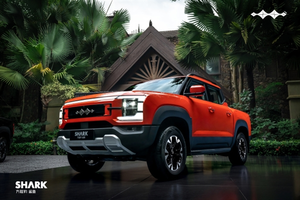
July 3, 2026 – Hours after Xpeng Motors staged the China debut event for its MONA L03 model, He Xiaopeng, Chairman of Xpeng Group, shared his forward-looking insights into China’s fast-evolving intelligent driving assistance industry during media interviews.
A landmark global regulation governing automated driving, known as ADS GTR, was formally released by the United Nations back in June this year, with China standing as one of the core drafters that shaped its key frameworks. According to He, China has secured a leading global position across two critical dimensions of intelligent driving: the real-world performance delivered by domestic automotive firms, and the development of standardized regulatory systems for autonomous mobility.

The UN-backed ADS GTR establishes unified technical standards covering all automation tiers ranging from L2 partial assistance to fully self-driving L5 systems. Its provisions for L2-level driving functions are set to take effect worldwide this December, a development He framed as a major strategic advantage that will smooth Xpeng’s overseas market expansion roadmaps.
Drawing on his role as a delegate during this year’s national two sessions, He Xiaopeng also revealed a formal policy proposal he submitted to authorities. The core suggestion urges domestic regulators to accelerate the rollout of advanced autonomous driving technology by skipping the transitional L3 tier entirely and channeling resources directly toward commercializing L4 and L5 mobility solutions.
He reflected on his shifting outlook on high-level autonomous technology. He admitted he remained skeptical about the viable mass rollout of L4 and L5 systems as recently as two years ago. Yet explosive progress in artificial intelligence over the past 24 months—especially breakthroughs within physical AI, a field critical to self-driving perception and decision-making—has drastically altered his assessment of the industry’s trajectory.
Fueled by rapid AI iteration, the Xpeng chief voiced full confidence in an accelerated timeline for autonomous vehicle deployment. Over the next three to five years, he predicts both L4 and even L5 fully autonomous systems will move beyond limited trials to widespread real-world use. These next-gen driving systems will deliver safe, seamless and highly efficient navigation across all traffic scenarios, with the overall speed of technological commercialization poised to outpace nearly every industry insider’s current projections.