



November 3, 2026 – Baidu Apollo has unveiled Apollo World, an agent-driven, full-modality world model for physical AI, and proposed a “2+3” evaluation framework for judging world models. The system is already being used to test and validate Apollo Go’s global autonomous driving operations.
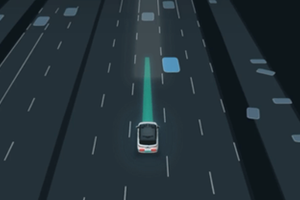
Unlike conventional simulators that rely on scripted traffic, Apollo World models vehicles, pedestrians and other road users as AI agents capable of decision-making and interaction. It can generate camera images, LiDAR point clouds and other multi-modal observations in real time, allowing an autonomous driving system to perceive, decide, act and receive feedback in a closed loop. The model supports complete trips from any origin to any destination, covering ride-hailing, passenger pickup and drop-off rather than isolated intersections.

Baidu’s “2+3” standard separates basic requirements from advanced capabilities:
Causality: the model must follow one-way time progression, predicting the next state from the current one instead of stitching frames together.Interactivity: it must respond dynamically to actions injected by the driving system.Physical accuracy: simulated states should remain consistent with real-world physics and transfer back to physical deployment.Persistence: long-running simulations should avoid drift in objects and scene details.Real-time performance: inference latency should stay low as scene complexity increases.
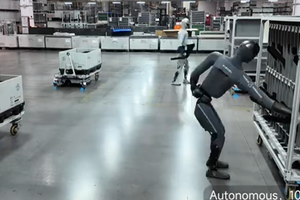
Baidu said Apollo World can simulate up to 100,000 km of virtual driving per day, roughly equivalent to about three years of real-world testing with a safety driver. Apollo Go has deployed across 28 cities globally, with cumulative autonomous driving mileage exceeding 350 million km and fully driverless mileage surpassing 240 million km. The company also said the underlying technology stack could extend to robotics and broader physical AI applications.