





November 2, 2026 – The first CMG World Robot Mount Tai Challenge kicked off in Tai’an, Shandong, putting humanoid robots, quadrupeds, exoskeletons and other embodied-AI systems through a real mountain trail rather than a laboratory track. The main route runs about 3.9 kilometers from Hongmen to Zhongtianmen, with more than 3,100 stone steps and roughly 600 meters of elevation gain.
The competition includes four official events — humanoid robot racing, legged robot racing, legged robot load-carrying and exoskeleton-assisted climbing — plus an all-terrain mobility challenge. The humanoid race is split into two parts: a 1.6-kilometer, 600-step official section from Hongmen to Doumu Palace, and an optional harder leg up to Hutian Pavilion.
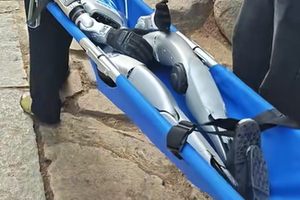
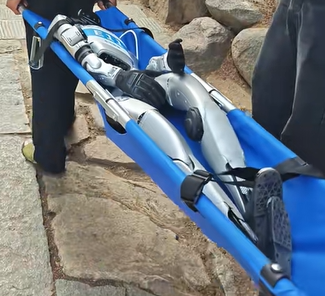
One of the most discussed moments involved a Unitree G1 humanoid robot entered by the Yongda Zhicheng team. The operator described it as a G1 development version, the same model family that appeared on the Spring Festival Gala stage. The robot did not finish; it overheated during the climb and was withdrawn for safety, then carried downhill on a stretcher. The team’s operator said the decision was made to avoid damaging the servos, noting that afternoon solar radiation, sustained high-load climbing and slow heat dissipation on granite steps pushed the thermal system close to its limit.
Unitree itself did not enter as an official competitor. The company made a similar clarification after the April 2025 Beijing Yizhuang humanoid half-marathon, when a customer-purchased G1 modified by an independent team fell during the race. Unitree said at the time that different development stacks and operating teams can produce very different results, and that third-party entries should not be treated as official product performance.
Elsewhere on the course, some robots staggered, slipped or needed assistance in the final sections, while others were carried or suspended before the start to conserve energy. In the quadruped speed event, the winning robot reached Zhongtianmen in 43 minutes and 41 seconds, far faster than most human visitors, though it still ran with an operator following closely.
The event is less a polished product showcase than a stress test for embodied intelligence. Irregular stone steps, narrow treads, steep slopes, variable lighting and continuous climbing expose gaps in perception, balance control, thermal management, endurance and human-in-the-loop operation. For now, these machines can demonstrate impressive bursts of mobility, but long-duration, fully autonomous mountain operations remain an engineering challenge rather than a solved problem.